Published by HALOX Co.
What an oversize permit actually is
How Texas, California, and Washington authorize a move past legal size or weight, what they require of the load, the route, and an escort, and what the permit leaves to the title and the registration.
A yellow sign with black letters reading OVERSIZE LOAD is mounted at the rear of the trailer. The sign marks the load. The permit is the document that lets the truck make the move.
The Texas Department of Motor Vehicles says a vehicle or load that exceeds Texas legal size and weight limits must have an oversize/overweight permit, and an authorized route when one applies, before it travels on a Texas public roadway. Caltrans may issue a special permit, on application and if good cause appears, to move a vehicle or load past the maximum size or weight on the state highway system. The Washington State Department of Transportation says a vehicle over legal dimensions or weight needs a permit before it enters the state or moves inside the state.
Texas’s size page sets the line a vehicle may cross without a permit. Width for a vehicle other than a passenger vehicle, load included, is 8 feet 6 inches, measured across the outside points and excluding safety devices. Height is 14 feet, from the roadbed to the highest point of the load or the vehicle. Gross weight is 80,000 pounds, and that weight includes the vehicle and the load. Length depends on the combination. Washington’s permits page lists 8 feet 6 inches wide, 14 feet tall, 53 feet for a tractor and trailer, 40 feet for a single unit, and 75 feet overall for a truck and trailer, with 3 feet of front overhang and 15 feet of rear overhang. Its weight page uses tire size, axle weight, and a weight table together, and the lesser of the three governs. The Caltrans permits page describes the single-trip type for loads greater than 8 feet 6 inches wide, 14 feet high, and over 80,000 pounds.
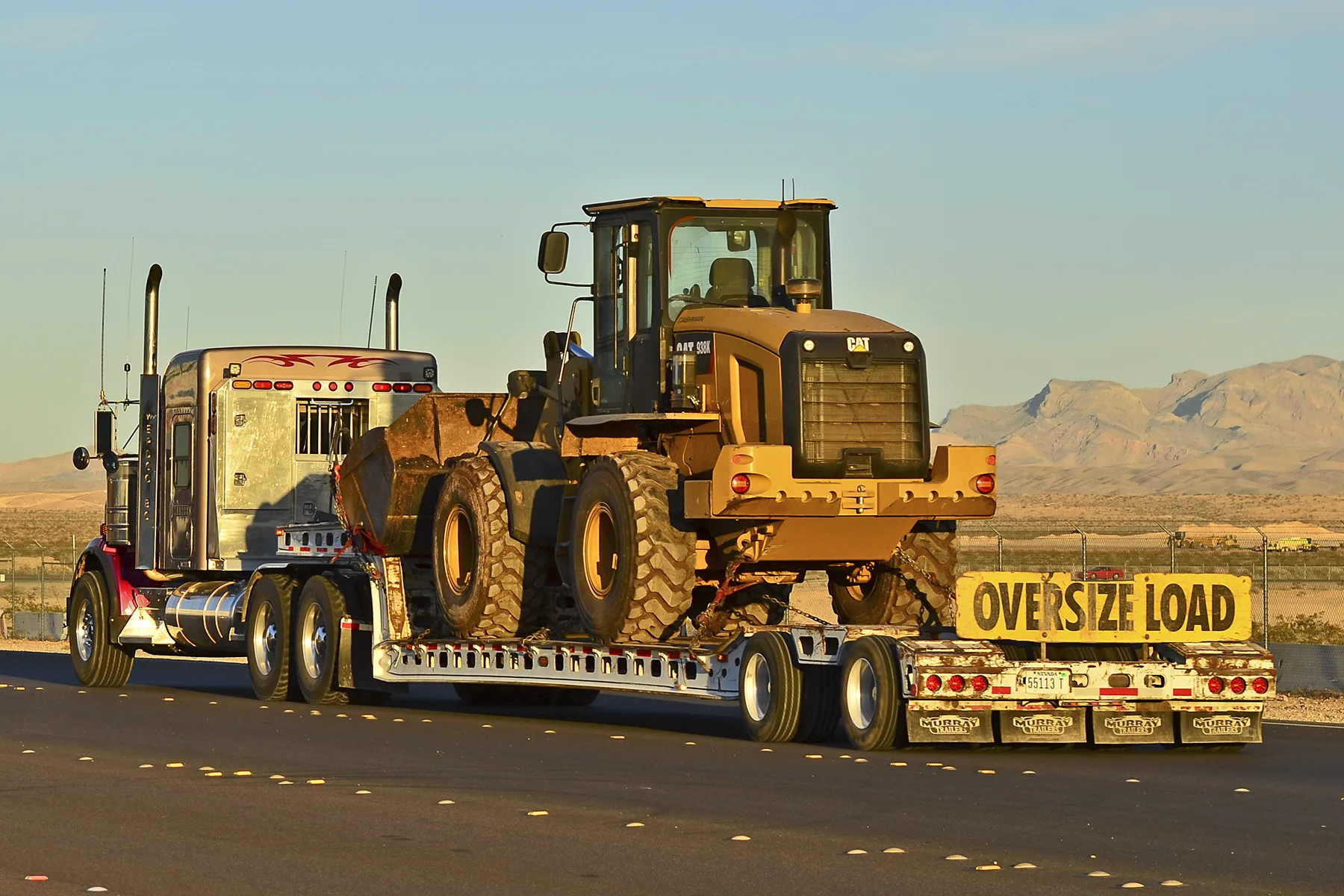

The sign at the rear of that trailer is the marker on the highway, and the permit is the document for the move.
A load that can be taken apart does not get the single-trip permit
Washington issues these permits only for loads that cannot be divided. If the load, or any part of it, can reasonably be reduced, it has to be reduced, and the permit will not be granted. California’s application page calls the same idea non-reducible. The load cannot be broken down into smaller parts and hauled on a legal tractor and trailer. If the combination or the cargo is not eligible, that page says it cannot travel in California legally and has to be reduced to the legal size and weight. Texas’s general single-trip page is for a non-divisible vehicle or load. More than one item may be hauled only when the extra item does not cause, or increase, a dimension or a weight past the legal limits. The page’s example is steel plates that are already 10 feet wide. They may be stacked if the stack stays at or under 14 feet high and the weight stays inside the legal axle and gross limits.
The single-trip permit is not every permit on these menus. A divisible load is not refused every permission. Texas’s permit list includes an over-axle and over-gross tolerance for hauling divisible commodities. Washington’s permit list keeps a length permit for divisible loads on a semitrailer apart from the single-trip permit, which that list limits to non-divisible loads. The single-trip test is the one the three pages above describe. A different name on the same menu is a different permission.
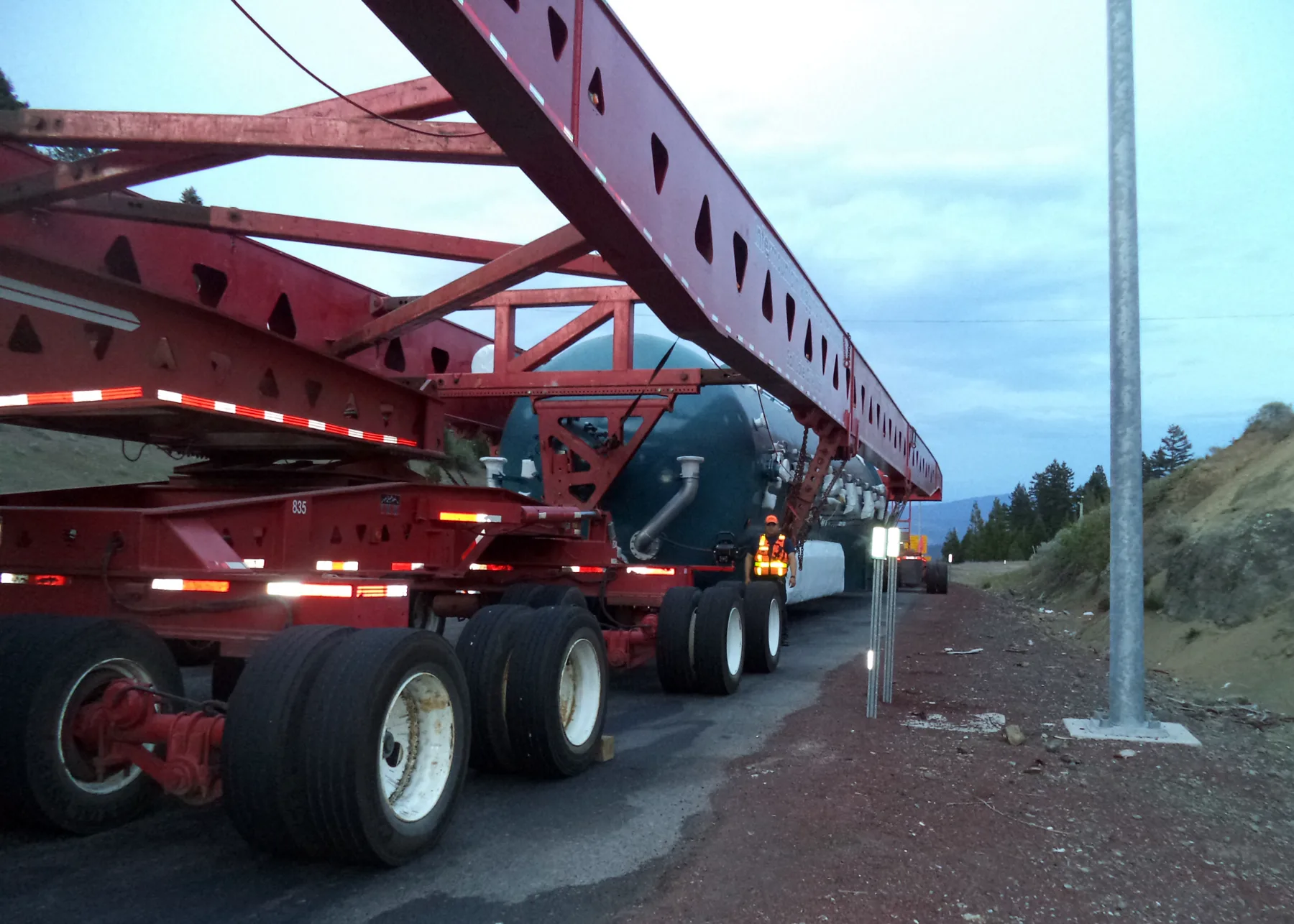

The cylinder stays in one piece on the girder frame, and the Oregon Department of Transportation’s description of the photograph puts the move at 20 axles, 776,000 pounds gross, 350 feet long, and 21 feet wide, with three pilot cars, figures for this move and not a limit in Texas, California, or Washington.
The route and the days are the permission
Texas’s general single-trip page allows one movement, during the times the permit specifies, from a named origin to a named destination. It covers a non-divisible vehicle or load up to 254,300 pounds. A heavier gross weight, a weight past the maximum allowed on an axle or an axle group, or a weight past 200,000 pounds with less than 95 feet of axle spacing, is a superheavy single-trip permit instead. Above 200,000 pounds the same page also wants a shipper’s certificate of weight with the application. A move wider than 20 feet, higher than 18 feet 11 inches, or longer than 125 feet needs a route-inspection certification on file before the permit is issued.
The permit list also offers 30-day, 60-day, and 90-day width and length permits for non-divisible loads, and it says to use the width permit and the length permit together. A single continuous movement is one clock. A permit measured in days is another. On holidays, the size page sets the maximum it will permit at 14 feet wide, except for manufactured housing, 16 feet high, and 110 feet long.
California’s single-trip page is one-way, from one point to another. A return trip needs another permit if the vehicle is still over legal size, because the road back may be a different alignment with different clearances. The permit is valid for seven consecutive days and may be issued up to three days before travel. Loaded height has to clear the lowest structure on the route by 3 inches. The page caps length at 135 feet. Its width ceilings depend on the route: 14 feet in general, 15 feet without a California Highway Patrol escort on green, blue, and brown routes, and 16 feet on yellow routes. The permit system has the applicant build the route in a database that checks the route for height and weight violations, then submit that route with the application. An approved single-trip permit can be printed from that system.
The Caltrans permits page keeps an annual permit for a smaller excess, up to 12 feet wide and 14 feet high, and it prohibits annual-permit travel on red routes. The application page describes a variance permit for a vehicle over 15 feet wide, 17 feet or more high, or over 135 feet long. That variance is the next paper, not a wider reading of the single-trip permit.
Washington’s permit list calls the single-trip permit a three-day, route-specific permit for non-divisible loads. The permits page says the carrier provides the route and has to verify restrictions and overhead clearance. The self-issue page says road and bridge restrictions are printed on the permit and the carrier has to follow them, and that over-height clearance is the carrier’s responsibility, not the department’s. A self-issued single trip stops at 16 feet wide, 16 feet high, 125 feet of load length, and 200,000 pounds. Past any of those, the permits page calls the move a superload and does not offer it for self-issue. The permit list also has a monthly permit, dimensional only, for a non-divisible load up to 14 feet wide, 15 feet high, and 125 feet long. That monthly paper is not the three-day route permit.
Washington’s permit conditions require a signed permit in the power unit at all times. They also prohibit overdimensional loads on the holidays the sheet names, and on the afternoon before those holidays. Texas’s holiday rule is a lower maximum on the days its size page calls holidays. Washington’s is a ban on the overdimensional move for the days the sheet names.
An escort is a condition of the move
Texas’s escort page ties the escort to the dimension. For a width past 14 feet and up to 16, it wants one escort in front on a two-lane highway and one in the rear on a multi-lane highway. Past 16 feet of width, it wants one in front and one in the rear on every road. Past 17 feet of height, it wants a front escort with a height pole made of nonconductive metal. Past 18 feet of height, it wants that front escort and a rear escort. The escort carries a sign reading OVERSIZE LOAD or WIDE LOAD, on a yellow background with black letters, and the page says the sign must not be used at any other time. The department may also require a law-enforcement escort.
Washington’s conditions require an escort at a narrower width, and a height pole at a lower height, than the Texas page. Past 11 feet of width, front and rear escorts are required on two-lane highways. Past 14 feet of width, one rear escort is required on a multiple-lane highway. Past 14 feet 6 inches of height, one front escort with a height pole is required. The sheet says the department does not guarantee height clearances, and that a front escort with a height pole should be used on any route where the height is in question.
California’s single-trip page says the permits are subject to pilot car requirements. A load that exceeds those requirements for width, length, height, or a structure’s weight rating is subject to California Highway Patrol requirements. The width figures on that page include a 15-foot maximum without a Highway Patrol escort on green, blue, and brown routes, and a 16-foot maximum on yellow routes.
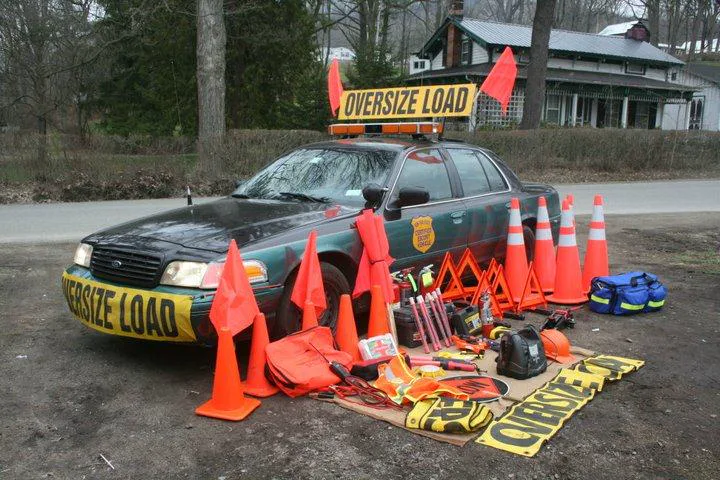

The roof sign, the bumper banner, and the gear laid out on the dirt are the escort’s equipment.
It does not title the truck or register it
The pages above authorize a move. They do not describe a change of owner. A title is the ownership record. A registration is the credential that lets the vehicle be on the road at its registered weight. An apportioned plate is that registration for a truck that travels in more than one member jurisdiction. It is not this permit.
Washington’s permits page sends vehicle licensing, including trip permits, to the Department of Licensing. Texas’s temporary-registration page is a separate permit for a vehicle that is unregistered, lacks reciprocity, or is not registered for the weight it needs. When an oversize combination needs that temporary registration, the page says to get it before applying for the oversize permit, and to enter the temporary tag number in the license-plate field of the application. The same page limits one-trip temporary registration to an unladen vehicle and says a laden vehicle is not eligible. A loaded oversize move is not that one-trip paper. California’s one-trip permit stands in for registration on one continuous unladen trip, and the manual says it is not valid for movement of a vehicle that requires an oversize permit from Caltrans.
A USDOT number is the federal identifier for the company. Texas’s single-trip page requires the number on the application, checks it against the Federal Motor Carrier Safety Administration’s system for an out-of-service order, and issues the permit in the company name on that record. If a number is not required, the page requires a permit surety bond on file. The number and the bond are conditions of issuance. Neither one is the permit. The shipper’s certificate of weight, when that page asks for it, is not the permit either.
Washington requires its own permit before a vehicle over legal size or weight enters the state. Caltrans issues its permit for the state highway system. Texas issues its permit for travel on Texas public roadways. Washington’s permits page also points to separate county and city contacts for local permits. The banner and the escort sign are equipment the move may have to carry. The title and the registration are other records. The permit is the route, the days, and the load the issuing office wrote down.
Sources
- TxDMV: Oversize/Overweight Permits — A permit and an authorized route, when applicable, before travel on a Texas public roadway; general single-trip for a non-divisible load and one continuous movement; 30-, 60-, and 90-day width and length permits; an over-axle permit for divisible commodities; temporary registration listed as a separate permit
- TxDMV: General Single-Trip Permits — One movement during the times on the permit, from a named origin to a named destination, up to 254,300 pounds; superheavy permit above that weight, above axle permit weights, or above 200,000 pounds with less than 95 feet of axle spacing; route-inspection certification above 20 feet wide, 18 feet 11 inches high, or 125 feet long; a shipper's certificate of weight above 200,000 pounds; stacking that must not create a new excess; USDOT number check and a permit surety bond when a number is not required
- TxDMV: Texas Size/Weight Limits — Legal width of 8 feet 6 inches for vehicles other than a passenger vehicle, height of 14 feet, gross weight of 80,000 pounds, and how each dimension is measured; holiday permit maximums of 14 feet wide except manufactured housing, 16 feet high, and 110 feet long
- TxDMV: Escort and Equipment Requirements — Escort count and placement by width and height, a nonconductive height pole above 17 feet, the OVERSIZE LOAD or WIDE LOAD sign and the rule that it not be used at any other time, and a law-enforcement escort when the department requires one
- TxDMV: Temporary Vehicle Registration — A separate registration permit obtained before the oversize permit when the combination needs it, with the temporary tag number entered in the license-plate field; one-trip temporary registration limited to an unladen vehicle
- Caltrans: Transportation Permits — Discretionary special permits for the state highway system; single-trip type described for loads greater than 8 feet 6 inches wide, 14 feet high, and over 80,000 pounds; annual permit up to 12 feet wide and 14 feet high with red-route travel prohibited
- Caltrans: Single Trip Permit — Non-reducible loads, one-way travel, seven consecutive days, issuance up to three days ahead, a separate permit for a return that is still over legal size, 3 inches of clearance under the lowest structure, a 135-foot length cap, width ceilings by route color, and pilot car and Highway Patrol requirements
- Caltrans: How To Apply — Non-reducible defined as a load that cannot be broken down and hauled on a legal tractor and trailer; a load that is not eligible has to be reduced; variance permits over 15 feet wide, 17 feet or more high, or over 135 feet long
- Caltrans: CTPS Information — Route Clearing Database checks a submitted route for height and weight violations; an approved single-trip permit can be printed from the system
- California DMV: One Trip Permit — A permit in lieu of registration for one continuous unladen trip, not valid for movement of a vehicle that requires a Caltrans oversize permit
- WSDOT: Commercial vehicle permits — A permit before entering the state or moving in it; permits only for loads that cannot be divided; legal dimensions; the carrier supplies the route and checks clearance; superloads are not self-issued; licensing and trip permits are sent to the Department of Licensing; county and city permits have separate contacts
- WSDOT: Legal vehicle weight — Gross weight governed by the lesser of tire size, axle weight, and the weight table
- WSDOT: Permit types & fees — Single-trip permit is a three-day route-specific permit for non-divisible loads; a monthly dimensional permit for a non-divisible load; a separate length permit for divisible loads
- WSDOT: Self-issue a permit — Self-issued single-trip limits of 16 feet wide, 16 feet high, 125 feet of load length, and 200,000 pounds; restrictions on the permit bind the carrier; over-height clearance is the carrier's responsibility
- WSDOT: Special Motor Vehicle Permit Regulations and Conditions — Signed permit carried in the power unit; escort placement at 11 feet of width, 14 feet of width, and 14 feet 6 inches of height; height clearances are not guaranteed; overdimensional loads prohibited on the holidays the sheet names and on the afternoon before
- Oregon Department of Transportation: Big load on the road — The agency's description of the photographed move: 20 axles, 776,000 pounds gross, 350 feet long, 21 feet wide, and three pilot cars
References checked .